
 We sell only what we manufacture at our facility in San Diego, California.
What’s Durometer?
When selecting rubber feet, recessed rubber bumpers, or protective components for a product, one important factor often overlooked is durometer. At Budwig Molded Products, understanding durometer helps customers choose the right material performance for their specific application. Whether you need soft rubber feet for grip and vibration reduction or harder bumpers for durability and support, durometer plays a critical role in product functionality.
So, what exactly is durometer?
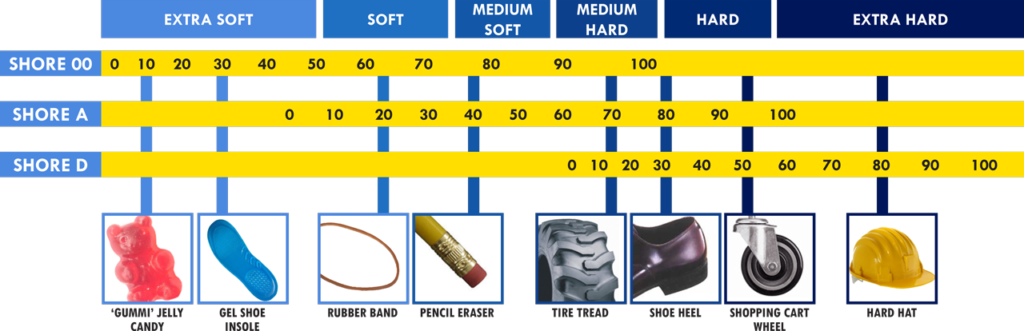
Durometer is the measurement used to determine the hardness of rubber, polymers, elastomers, and plastics. The term comes from the Shore durometer scale, developed by American metallurgist Albert F. Shore. This testing method measures how resistant a material is to indentation. In simple terms, softer materials have lower numbers while harder materials have higher numbers.
There are multiple Shore scales used across manufacturing industries, but the most common is the Shore A scale. Shore A is typically used for softer flexible materials such as rubber feet, protective bumpers, seals, and elastomer components. Harder plastics and rigid materials are often measured on the Shore D scale.
At Budwig Molded Products, one of the most commonly used materials for recessed rubber bumpers is Thermo Plastic Rubber (TPR) with an 87 Shore A durometer. When you see a part number that includes “TPR87,” it means the product is made from Thermo Plastic Rubber with a hardness rating of 87 on the Shore A scale. This hardness level is commonly compared to the feel of a skateboard wheel or the sole of a shoe.
Why is 87 Shore A so popular? Through extensive testing and real-world applications, this durometer has proven to offer an excellent balance of durability, flexibility, grip, and shock absorption. It performs well in a wide range of industrial, commercial, and consumer product applications.
However, not every application requires the same hardness level. Some products may need softer rubber feet to increase surface grip, reduce sliding, or improve vibration dampening. For those situations, Budwig also offers custom durometers such as 73 Shore A and 64 Shore A. Softer materials can help protect delicate surfaces while improving traction and noise reduction.
On the opposite end of the spectrum, certain applications require extremely hard and durable components. That is where the Shore D scale comes into play. Shore D materials are commonly used for rigid plastics and ultra-hard bumpers. For example, a product line labeled “PP65D” indicates a polypropylene component with a hardness rating of 65 on the Shore D scale.
Choosing the proper durometer is important because it directly impacts performance, longevity, grip, cushioning, and wear resistance. The right rubber hardness can improve product stability, reduce vibration, minimize damage to surfaces, and increase overall durability.
At Budwig Molded Products, customers can receive guidance on selecting the best rubber feet, bumpers, and molded components for their projects. Free sample quantities are available within the continental United States, allowing businesses to test materials before full production.
Learn more about recessed rubber bumpers and rubber feet.
Contact Budwig Molded Products today with any questions about durometer, rubber hardness, or selecting the ideal component for your next application.